
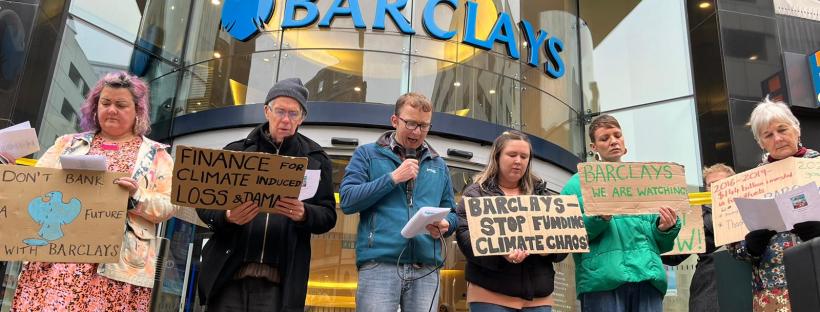
Today Christian Aid, one of the UK’s largest development charities, has ended its relationship with Barclays, Europe’s biggest funder of the fossil fuel sector, after eight years.
With an income of £78.4 million last year, a strong reputation among faith communities and good brand recognition among the broader public, Christian Aid’s decision to dump Barclays could further impact the reputation of the bank, which benefits from and publicises its relationships with ethical and sustainable clients.
This month Barclays has come under fire for its sponsorship deal with Wimbledon, with celebrities and campaigners criticising the bank for ‘sportswashing’, that is attempting to cover up its harmful activities by buying access to popular and sustainable brands.
Investors and campaigners are also targeting Barclays over its financing of new oil and gas, as the world experiences unprecedented levels of global warming and resultant devastating climate impacts. Since 2016, Barclays has financed fossil fuel companies to the tune of $190 billion, making it the world’s seventh largest funder of fossil fuels globally.
Barclays needs to publish a policy to stop extending all types of financing (loans and underwriting) to coal, oil, and gas clients that are still exploring and developing new fossil fuels. Even though the bank has set a target to reduce real-world emissions by 40% by 2030, the lack of a coherent policy to achieve this has drawn concern from campaigners and investors.
Competitors HSBC, Lloyds, and NatWest have all taken the first step of stopping direct project financing to new oil and gas. But banks need to go much further and address their financing at the client level, through general purpose loans and underwriting of bonds.
Dr Rowan Williams, Former Archbishop of Canterbury and former Chair of Christian Aid, said: ‘It is essential that banks like all public and corporate bodies be held accountable for the use of their resources in the context of our global emergency, and I welcome the clear stand that has been made by Christian Aid on this matter.’
Tony Burdon, executive director of Make My Money Matter, said: “From savings, to pensions, to bank accounts – the choices over where individuals and organisations put their money are some of the most important we take in the battle against climate change. Christian Aid’s decision shows the power of making your money matter – and sends a clear signal to Barclays that it’s time to stop their dangerous practice of financing fossil fuel expansion. We hope all organisations follow Christian Aid’s lead, and make sure their money is complementing their values, not contradicting them.”
Rev Darrell Hannah, Chair of Operation Noah, a Christian climate charity said: “As Barclays continues to fund fossil fuel companies’ exploration and development of new fields, it is imperative that Christians, and others, cease to do business with Barclays. The International Energy Agency, the Intergovernmental Panel on Climate Change and the UN have warned that no such developments are compatible with keeping global heating below 1.5º C. The recent deadly heatwaves across Europe and the breaking of global temperature records should serve as a reminder of the danger posed by Barclays and the companies they bankroll. Christian Aid is to be congratulated for this momentous and, hopefully, trend-setting decision.”
Rev Helen Burnett, a member of Christian Climate Action and volunteer fundraiser for Christian Aid, said: “There are many other charities still banking with Barclays. It’s untenable that charities can say that they stand against climate change, and the suffering it means for vulnerable people around the world, while at the same time banking with the biggest funder of fossil fuels in Europe. If you fund climate change, you fuel climate change. Charities and other organisations that choose Barclays are choosing to fund suffering.
Christian Aid has acknowledged this and has taken the active step to move away from Barclays and this deserves celebration. As more charities decide to take the same step, those dragging their heels will come under increasing public scrutiny.”
Ruairidh Fraser, a researcher at Ethical Consumer says: “We welcome Christian Aid’s decision to move away from Barclays. Barclays is the biggest funder of fossil fuel infrastructure in Europe. While high street rivals like HSBC and NatWest have at least restricted some new oil & gas funding, Barclays remains free to finance fossil fuel expansion. We are calling upon individuals and organisations to withdraw their money from Barclays until it withdraws its money from the most destructive industries on the planet.”
Canon Pete Lippiett is a priest from Hampshire, who has been a Christian Aid supporter for 60 years. He and his wife have run Christian Aid events and fundraisers in their parishes for the best part of 50 years: “Thank goodness that Christian Aid has moved away from Barclays. It was a real issue of stress for me and I did wonder whether I could continue to fund raise for them. I’m so glad they did the right thing. I knew they would.”
 Christian Climate Action