
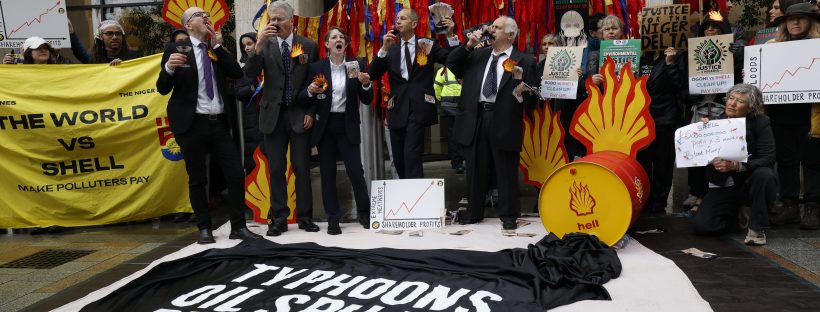
Christian Climate Action campaigners, and allies from across the UK, the Philippines, and Nigeria joined forces on 19th May to demonstrate international solidarity and support for legal action against Shell at the company’s Annual General Meeting.
Three members of Christian Climate Action attended the AGM to challenge the board by asking questions related to Shell’s climate and environmental impacts in the UK and abroad. The AGM was held in a hotel at Heathrow which is covered by an anti-protest injunction.
Other members of Christian Climate Action supported a demonstration, organised by grassroots activists, at Shell’s London HQ, which brought the human cost of Shell’s recent $6.92 billion quarterly profit to the company’s front door. A massive oil barrel leaked out fake oil and messages of destruction, while campaigners dressed as oil executives drank from ‘oil’-filled champagne glasses. The stunt was accompanied by crowds standing behind a banner reading “The World vs Shell.”
Catherine Fish, a member of Christian Climate Action who attended the Shell AGM, said: “I am here because, as a Christian, I am called to be in solidarity with those in the front line of climate change and the environmental degradation that is driven by Shell putting its pursuit of profits before life itself.”
This comes just after Shell announced massive profits and faced criticism for ‘profiteering’ from conflict and the rise in global fuel prices. The groups involved held the demonstration to highlight how fossil fuel dependence deepens both the climate crisis and the rising cost of living.
Uniting two frontline struggles for justice in the Philippines (Odette Case) and the Niger Delta, the demonstration was organised with both communities who have lodged cases against Shell in London courts.
Joan Jayma, a claimant from one of the affected communities, said: “Filipinos, Nigerians, and many other voices around the world are united in holding Shell accountable for its role in the destruction of the environment, livelihoods, and countless lives. Bringing them to court marks the beginning of justice—not only for communities long harmed by fossil fuel companies, but also for our children, whose future is at risk because of the lack of accountability of major oil corporations.”
Attorney Ryan Roset, Legal Rights and Natural Resources Center (LRC) Senior Legal Fellow, said “Communities in the Global South have long disproportionately suffered the effects of the climate crisis from the unfettered business interests of fossil fuel companies, who flex their earnings to their shareholders. Those in power, still enamored by antiquated economic systems, could not care less about the urgency of this catastrophe, and hide behind token solutions with insignificant impact. Climate change, however, does not lie in the future; it is here and now, and its effects are becoming more palpable each year. Marginalized communities the world over have had enough, and are taking the legal fight against corporate actors, and governments to seek accountability, and shape the policy landscape. This wave of climate litigation is growing, yet it is far from reaching its crest.”
Super Typhoon Odette, a typhoon made more severe and more likely by climate change, affected more than 8 million people in the Philippines, many of whom lost their lives, their homes, and their livelihoods.
In the Niger Delta, thousands of members of the Ogale and Bille communities are suing Shell and its subsidiary SPDC for oil spills, asserting that their oil-producing activities in the region caused environmental damages, destroyed livelihoods, and caused health problems in local communities.
The demonstration comes a day before the UK Climate Change Committee will release an Independent Assessment of UK Climate Risk. The report, five years in the making, will provide comprehensive evidence on national climate risks and, for the first time, set out actionable solutions to address them.
Despite these risks, Shell’s annual report and accounts (2026) reveal that it is continuing to follow an oil and gas agenda, fueling climate change:
- In 2024, Shell emitted four times the annual emissions of the Philippines.
- 70% (or over two-thirds) of Shell’s investment in 2025 went towards oil and gas, whilst just 7% was invested in “low-carbon energy solutions”.
- In 2025, for every $1 invested in “low-carbon energy solutions”, Shell invested $9 in oil and gas and handed $15 to shareholders.
Photos: Fossil Free London

